
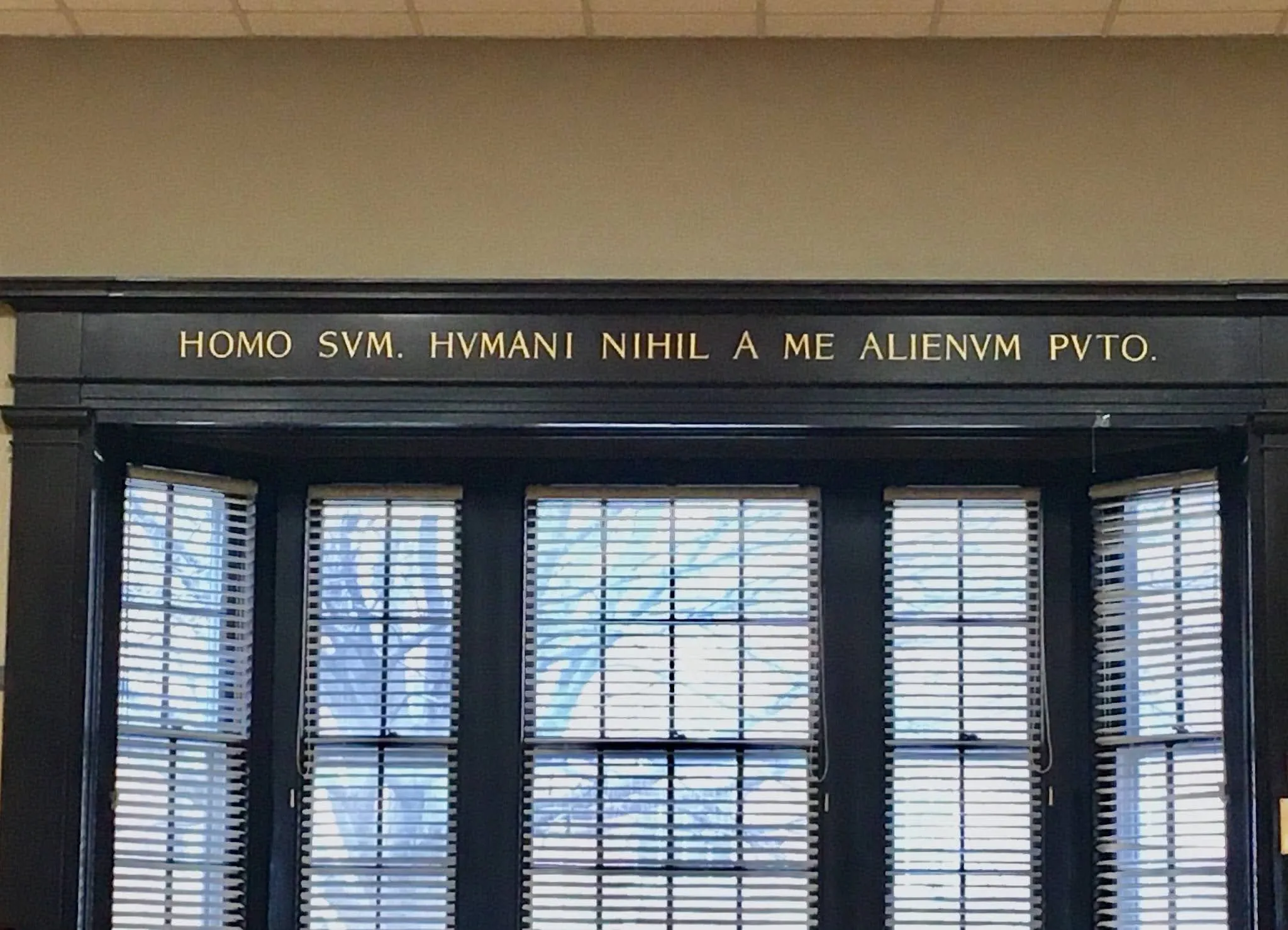
Visitors to Channing Hall may notice a simple Latin inscription painted on the wall:
Homo sum: humani nihil a me alienum puto.
Translated, it means:
“I am human: I consider nothing that is human alien to me.”
Though these words were written more than two thousand years ago, their message continues to resonate. They invite us to consider what it means to recognize our connections with one another and to approach the lives of others with curiosity, compassion, and care.
The phrase comes from the play Heauton Timorumenos (The Self-Tormentor), written around 184 BCE by the Roman playwright Terence, whose Latin name was Publius Terentius Afer. Terence’s own life challenged the boundaries of the world in which he lived. Born in North Africa, he was enslaved and brought to Rome. His owner recognized his intelligence and talent, provided him with an education, and eventually freed him. Terence went on to become one of Rome’s most celebrated playwrights.
In the original play, the phrase is spoken by a character named Chremes, who is criticized for involving himself in another person’s affairs. His response is essentially that concern for others is not interference—it is part of being human. If we share the human experience, then the joys, struggles, and challenges of other people matter to us.
Over the centuries, the meaning of this simple line expanded far beyond its original context. It became a reminder that other people’s lives are never completely separate from our own. Their hopes, struggles, dreams, and experiences are part of the larger human story we all share.
That idea reflects the value of Love at the heart of our faith. To recognize that nothing human is alien to us is to practice empathy—to remain open to the experiences of others and to understand that compassion begins with a willingness to listen, learn, and care.
The phrase also reminds us of Interdependence. Our lives are connected in ways we do not always see. The well-being of our communities depends on our willingness to notice one another, respond to one another, and recognize that caring for others strengthens us all.
The journey of this phrase across centuries and cultures reflects Transformation. Words that began as part of an ancient Roman comedy have continued to evolve, taking on new meaning in different times and places. What began as a character’s response in a play has become a lasting invitation to practice understanding and connection.
The inscription came to Albany UU through the encouragement of Rev. M. McKarl Nielsen, who served as our minister from 1947 to 1951. Recognizing the enduring wisdom of these words, Rev. Nielsen encouraged the congregation to paint the quotation on the wall of Channing Hall. Since then, generations of members and visitors have encountered this quiet reminder of our shared humanity.
Today, these words continue to offer a simple but profound invitation:
Homo sum: humani nihil a me alienum puto.
I am human. Nothing human is foreign to me.
As we pass this inscription in Channing Hall, we are reminded that building a more caring and just community begins with seeing one another more fully. The ancient words invite us to approach each person with curiosity, compassion, and the recognition that we belong to one another.