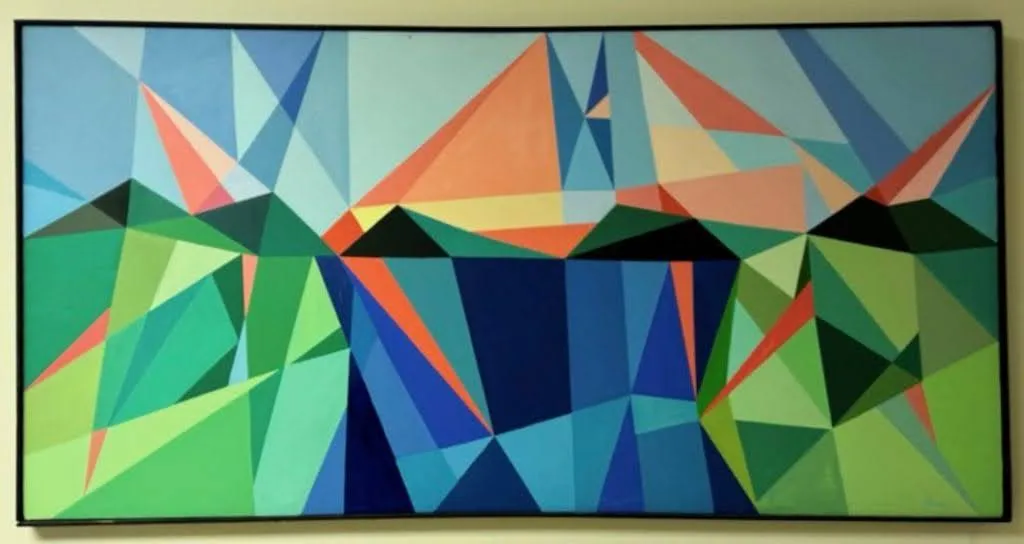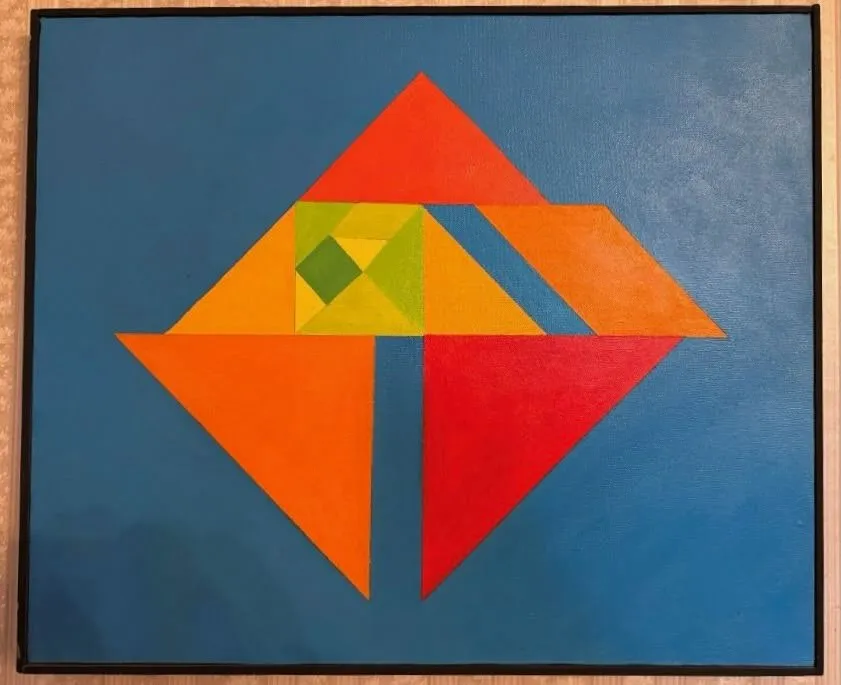
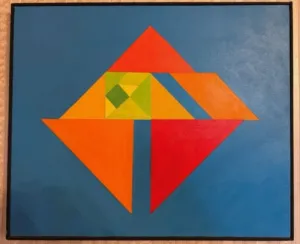
The two acrylic paintings by Margaret Gelbach Foster displayed at Albany UU invite us to look closely. Their carefully arranged shapes and colors may seem simple at first, but they reveal the work of an artist who spent her life exploring how we see, understand, and connect with the world around us.
Known as Marge to her friends, Margaret Gelbach Foster (1921–2002) was an active member of the First Unitarian Society of Albany for nearly 40 years. She was an artist, educator, traveler, and lifelong learner whose curiosity shaped both her work and her life.
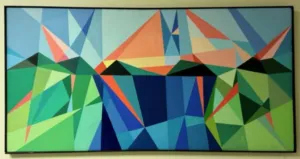
These two untitled paintings are examples of Geometric Abstraction, an artistic approach that uses shape, color, and composition rather than recognizable images or traditional subjects. The upper painting reflects Hard-Edge Painting, a style that emerged in the 1950s and 1960s with its emphasis on precision, clarity, and carefully defined forms. The lower painting draws inspiration from the traditional Chinese tangram puzzle, using seven geometric shapes arranged to create a larger design.
The tangram offers a fitting way to understand Foster’s work. Each individual piece has its own shape and purpose, but the full image only appears when the pieces come together. Her paintings remind us that difference does not prevent connection; often, it is what makes the whole more interesting and complete.
That same idea can be seen throughout Foster’s life. She was constantly gathering new experiences and perspectives. She earned both a Bachelor of Science and a Master of Science from the University of Wisconsin, studied at the Fine Arts Center in Colorado Springs, and received a Carnegie Foundation grant for study in London.
Her artwork often reflected the places she lived and visited, including Chicago, Colorado, Lexington, Kentucky, Albany, and countries throughout Europe, China, and Russia. Rather than seeing the world through a single lens, Foster allowed new environments, cultures, and experiences to expand her understanding of what art could be. Her life reflected Pluralism—the belief that our understanding grows when we remain open to many perspectives and ways of seeing.
Foster also shared her creativity through teaching. Over the course of 20 years, she taught at Monticello College, Transylvania University, and Maria College in Albany. Through her work as an educator, she offered her knowledge, encouragement, and passion for art to generations of students.
That generosity continued beyond the classroom. Foster’s paintings were exhibited widely and became part of permanent collections, including those of SUNY Albany and the State of New York. Yet her legacy at Albany UU is not only found in the artwork she left behind. It is also found in the example she set as a member of this community: someone who continued learning, creating, and sharing throughout her life.
Foster’s paintings invite us to consider Interdependence. Just as individual shapes become a unified composition, individual people contribute to the life of a community. Each person brings unique experiences, talents, and perspectives, and together those pieces create something that none could create alone.
Her work also reminds us of Transformation. A collection of simple shapes becomes a work of art. A lifetime of experiences becomes a creative vision. A community of individuals becomes something richer when people bring their gifts and share them with others.
As we encounter Margaret Gelbach Foster’s paintings at Albany UU, we are invited to slow down, look carefully, and appreciate the many ways creativity helps us understand ourselves and one another.
Like the pieces of a tangram puzzle, each of us contributes something essential to the larger picture.
Photo Gallery