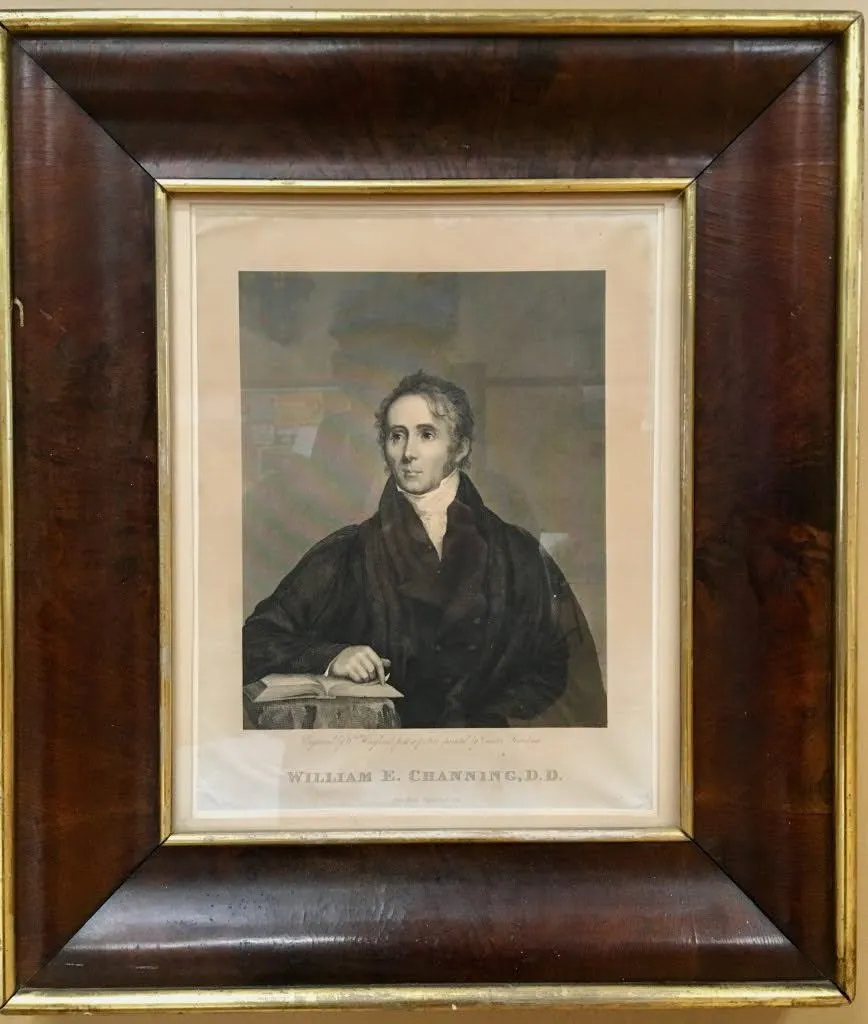
Portrait of William Ellery Channing
b.1780 Boston, Mass. – d.1842 Bennington, Vermont
Engraving ca. early 19th century. Photocopy
If you have spent time at Albany UU, you have probably attended a meeting, shared a meal, or enjoyed coffee hour in Channing Hall. It is one of the places where our congregation gathers most often—a space for conversation, connection, and community.
But have you ever wondered who William Ellery Channing was, and why this central gathering space bears his name?
William Ellery Channing (1780–1842) was one of the most influential figures in the early Unitarian movement. A Boston minister and theologian, he helped shape a new vision of religion centered on freedom of conscience, the use of reason, and the ongoing exploration of faith and meaning. He is also remembered as one of the founders of Harvard Divinity School and as a leader in challenging the strict Calvinist theology that dominated much of New England in his time.
What made Channing especially influential was not that he believed he had all the answers. It was that he believed questions mattered.
Throughout his life, Channing encouraged thoughtful discussion, respectful disagreement, and a willingness to reconsider ideas in light of new understanding. He believed that faith should engage both the mind and the heart, and that honest reflection could lead people toward deeper truth.
That spirit continues in the space that bears his name. Channing Hall is where Albany UU members gather to exchange ideas, make decisions, learn together, and strengthen relationships. Every conversation held here carries forward a tradition of curiosity, dialogue, and shared exploration.
Like many historical figures, however, Channing’s story is complex.
He lived during a time when slavery was deeply woven into American society, and members of his own family benefited from that system. As a child, he was cared for by Duchess Quamino, a formerly enslaved woman whose intelligence, determination, and entrepreneurship made a lasting impression on those who knew her. While working in the Channing household, Quamino built a successful catering business and became a respected member of her community. Channing later honored her life and character on her gravestone.
Over time, Channing’s own understanding of slavery changed. He became an increasingly vocal critic of the institution and wrote extensively against slavery during the final years of his life. His willingness to continue learning, to examine his own beliefs, and to act on new understanding offers a powerful example of Transformation.
His evolving views also remind us that the work of Justice is ongoing. Recognizing injustice is only the beginning; it requires the courage to reconsider assumptions, speak out, and work toward change.
Channing’s belief in conversation, inquiry, and the exchange of ideas reflects Pluralism as well. He understood that communities grow stronger when people are willing to listen, engage thoughtfully, and explore questions together rather than simply defend what they already believe.
The portrait displayed in Channing Hall invites us to remember that our faith tradition is rooted not in certainty, but in curiosity. It reminds us that growth often comes through conversation, reflection, and the willingness to encounter perspectives different from our own.
Every time we gather in Channing Hall, we continue that tradition. We build community through shared meals, thoughtful conversations, difficult questions, and a commitment to learning together.
The name on the wall is not only a reminder of a person from the past. It is an invitation for us to continue the work he valued: asking questions, seeking understanding, and growing together.