
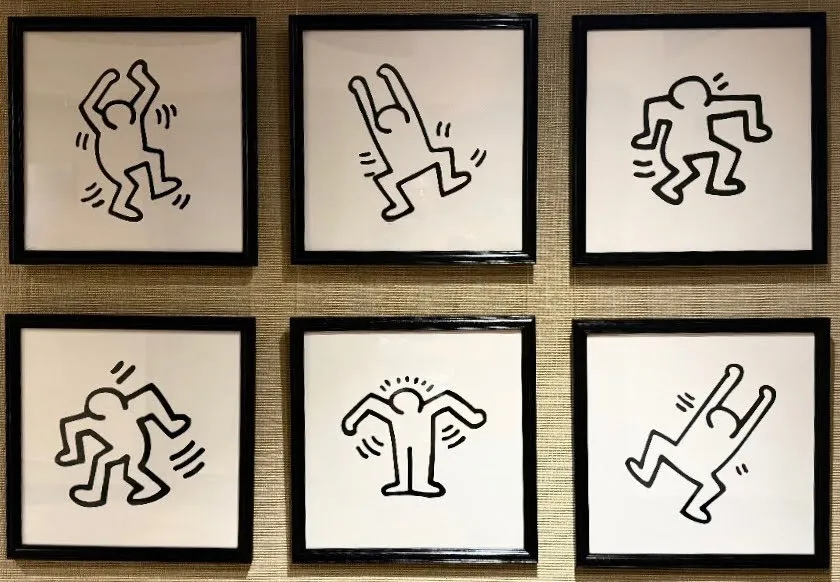
The black-and-white prints from Keith Haring’s Dancer series are easy to recognize. With bold lines, simple forms, and figures full of movement, they bring energy and life to Albany UU. At first glance, the dancing figures may seem playful and spontaneous. But behind their simplicity is the work of an artist who believed that art belonged to everyone and that creativity could help people connect with one another.
Keith Haring (1958–1990) emerged as one of the most recognizable artists of the 1980s. He first gained attention through chalk drawings on unused advertising panels in New York City subway stations. These drawings, created in a public space and available for anyone to see, reflected a belief that art should not be reserved for museums and galleries. Art, Haring believed, belonged in everyday life.
That commitment shaped his entire career. As his reputation grew, Haring continued creating public art that invited people to participate and engage. His work appeared on city walls, playgrounds, hospitals, and public spaces around the world. Through simple images that could be understood across languages and cultures, he explored themes of community, human rights, love, and social responsibility.
Haring also used his art to speak out against injustice. As an openly gay artist during a time of widespread discrimination, he created work that affirmed LGBTQ+ lives and challenged prejudice. After being diagnosed with AIDS in 1988, he became an advocate for AIDS education and compassion for those affected by the epidemic. He established the Keith Haring Foundation to support children’s programs and organizations working to address the AIDS crisis.
This commitment to Justice was central to Haring’s life and work. He believed that art could do more than decorate a space—it could raise awareness, challenge assumptions, and encourage people to care about one another.
Some of Haring’s most recognized works transformed public spaces into opportunities for reflection and action. His mural Crack is Wack addressed the devastating impact of the crack cocaine epidemic in New York City. Another large-scale mural painted along the Berlin Wall became a symbol of hope, unity, and the possibility of overcoming division.
Haring also believed that art should be available to everyone, not only collectors and institutions. Through his Pop Shop in New York City’s SoHo neighborhood, he created affordable prints, posters, and other items so that ordinary people could bring his work into their homes and daily lives.
That belief in sharing creativity widely has a special connection to Albany UU. One of our own members worked at the Pop Shop during the 1980s, creating a personal link between our congregation and Haring’s vision of making art accessible to all.
The Dancer series reminds us of the Generosity at the heart of Haring’s work. He shared his creativity freely, using his talents not only for personal expression but also to connect with others and support causes he believed in.
His work also reflects Love in action. The joy and movement of the dancing figures are not separate from his activism; they are part of the same vision. Haring believed that celebrating life, affirming people’s humanity, and standing against injustice were connected.
Today, the dancing figures at Albany UU invite us to consider the role of joy, creativity, and connection in building a better world. They remind us that justice work is not only about confronting what is wrong; it is also about creating spaces where people feel seen, valued, and welcomed.
As we encounter these prints in our shared space, they offer a simple but powerful message: every person has a story, every person has value, and every person has something meaningful to contribute.