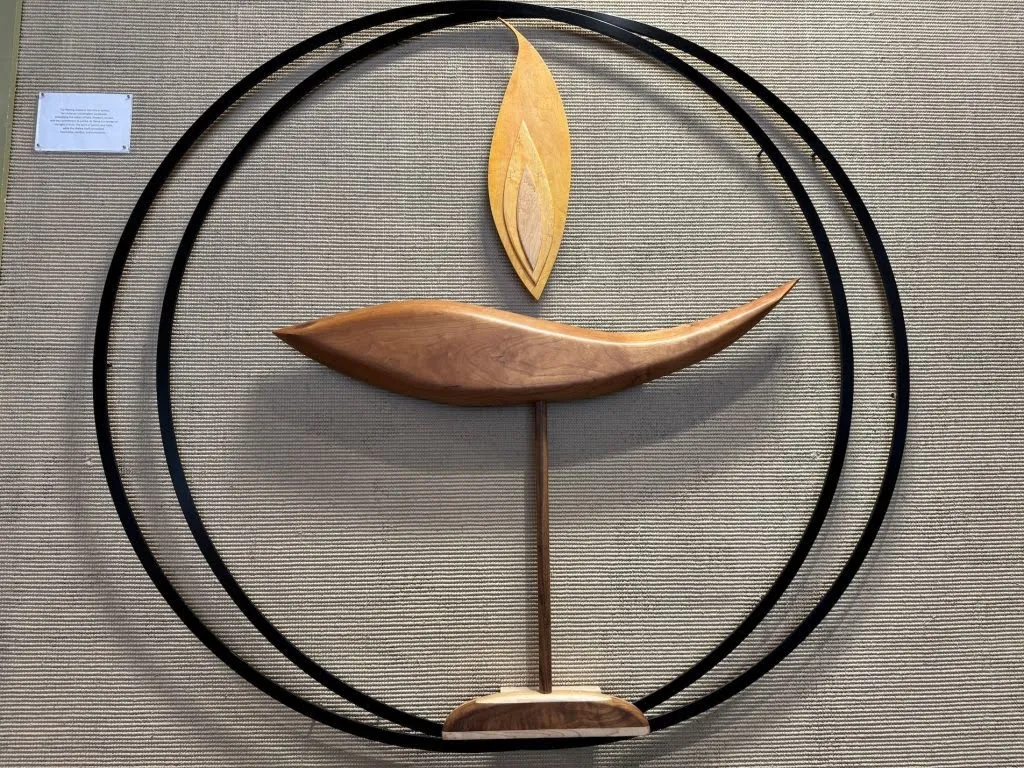
Visitors entering Albany UU often encounter one of our most recognizable symbols: the flaming chalice. Simple in design—a chalice with a flame rising from its center—the image has become a symbol of Unitarian Universalism around the world. But its story begins in a time of great uncertainty, when a small symbol helped carry a message of hope and safety to people in need.
The flaming chalice was created during World War II through the work of the Unitarian Service Committee (USC), an organization founded in 1940 to help people fleeing Nazi persecution. Dr. Charles Rhind Joy, executive director of the USC, recognized that the organization needed a symbol that would give its documents a sense of legitimacy while expressing the spirit of its humanitarian work.
Dr. Joy asked Hans Deutsch, an Austrian refugee and artist working with the USC, to create such a symbol. Deutsch combined two ancient images: the chalice, associated with sharing and community, and the flame, a symbol of light and hope. Together, they created an image representing sanctuary, compassion, and the belief that even in difficult times, people can bring light to one another.
During the war, the flaming chalice served a practical purpose. It helped identify USC documents and representatives who were assisting refugees and seeking to provide safety to people whose lives were threatened by persecution. Behind the symbol was a network of people working across borders and circumstances to help others survive.
That work reflected Justice. The USC did not simply witness suffering; its members took action to help people who had been targeted and harmed by systems of oppression. The flaming chalice became connected with the belief that compassion requires action and that we have responsibilities to one another.
The story of the chalice also reflects Love. Created in a moment of fear and uncertainty, the symbol represented a choice to care for others, even when doing so was difficult. It reminds us that love is not only something we feel—it is something we practice through the ways we respond to the needs of our neighbors.
Over time, the flaming chalice grew beyond its original purpose. A symbol created for a wartime humanitarian organization became a symbol embraced by Unitarian Universalists around the world. This evolution reflects Transformation: the way an idea, image, or community can change and deepen over time while remaining connected to its original purpose.
Today, lighting a chalice is part of worship and gatherings in Unitarian Universalist communities everywhere. The flame reminds us to seek wisdom, offer welcome, and carry hope into the world. It connects us to the people who came before us and invites us to consider what responsibilities we carry forward.
The history of the flaming chalice also reminds us of Interdependence. The symbol itself was created through collaboration: Dr. Joy’s vision, Hans Deutsch’s artistic gifts, and the work of countless people who helped refugees find safety. Its meaning continues because generations of people have carried it, interpreted it, and brought it to life.
At Albany UU, the flaming chalice is more than a symbol displayed in our building. It is a reminder of the kind of community we strive to be—a community that offers welcome, responds to suffering, and works together to bring more hope and compassion into the world.
A simple image—a cup and a flame—holds a powerful message: hope can be shared, compassion can be practiced, and each of us has a role in carrying the light forward.